
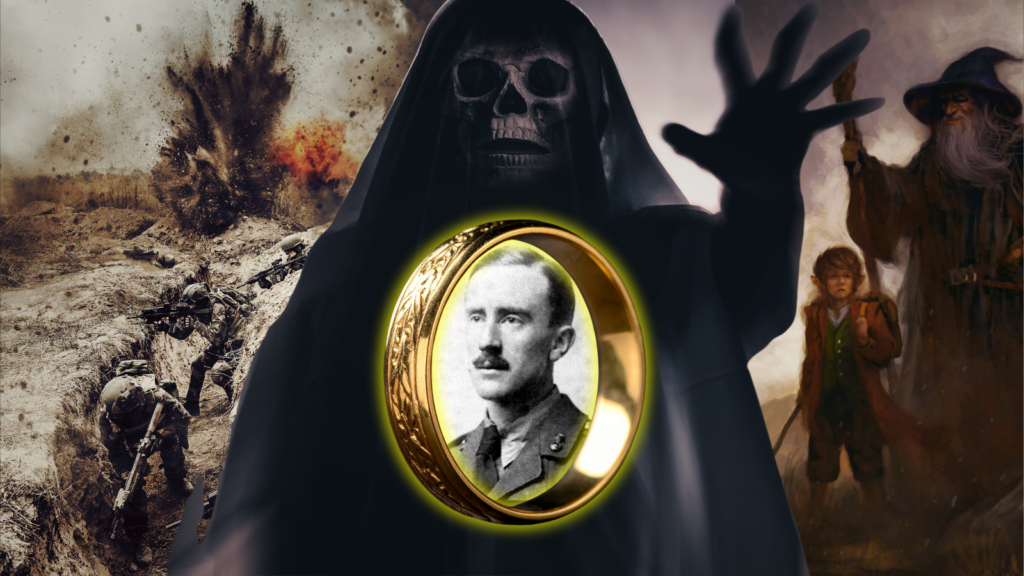
A young scholar of philology encountered death face to face on the battlefields of WW1.
The personal losses he suffered were devastating, but he channeled his experience of death into his career as a master of language and myth, and wrote the greatest piece of fictional literature of the 20th century.
When Death was Near
John Ronald Reuel Tolkien served as a signals officer in the 11th Lancashire Fusiliers (part of the 94th Brigade, 31st Division) during the Battle of the Somme in July 1916. The carnage of the first fully mechanised industrial world war was inescapable, and the stark reality of death was omnipresent. His original company took devastating losses—nearly all officers and most men were killed or wounded in the bloodied, muddy trenches beneath the smoke of war. Among those butchered before his eyes were his childhood friends, G.B. Smith, and Rob Gilson, who, along with Christopher Wiseman, had been a tight knit fellowship of aspiring poets and artists with Tolkien. The loss was devastating. In 1918, Tolkien wrote “All but one of my close friends were dead.”
Tolkien had stared into the empty black sockets of death on the western front, and had seen his friends and fellow soldiers succumb to its gaze.
In the anxious periods of waiting that alternate the intensity of combat, Tolkien processed his trauma by writing poems and verses on scraps of paper and supply wrappers – many of which would evolve into Goblin songs in The Hobbit or pieces of heroic tales. While recovering from trench fever in Birmingham, Tolkien began developing the mythology that became The Silmarillion and The Book of Lost Tales. The concept of Middle Earth had not yet consciously crystallized in his mind, but the seeds of an entirely different world, a secondary world, as Tolkien would put it, had been sown, and would continue to grow throughout his career.
A Career in Languages
After the war, he pursued a career in Philology, the study of language in its historical, literary, and cultural contexts—tracing words through ancient texts, manuscripts, and oral traditions to recover meaning, authenticate originals, and understand cultural evolution of language.
By 1918, he had secured a special lectureship in Anglo-Saxon at the University of Leeds. He rose swiftly to full Professor of English Language there in 1920, then claimed his dream post in 1925 as Rawlinson and Bosworth Professor of Anglo-Saxon at Oxford—a role he held until 1945, later transitioning to Merton Professor of English Language and Literature. The war’s shadow fueled his creative fire, while philology offered the rigorous scholarly foundation to perfect his linguistic skills.
It was during this span that he became keenly aware of the relationship between language and myth. In drafts of his essay On Fairy‑Stories, Tolkien says, in effect, that mythology and language co-evolve, and that for a truly successful invented language you must also create a people, a history, and a mythology to speak it.
He believed when a people first begins to speak, they are also beginning to tell stories; the growth of a language and the growth of its myths are co‑originating. Therefore, a “real” language does not float in the abstract. It is embedded in stories, rituals, poems, and a shared imaginative world.
The myths of these languages survive beyond the culture that created them when they are written down. Tolkien, deeply proud of his Anglo Saxon heritage, lamented the fact that with the exception of Beowulf and few other remnants, the majority of the myths and legends of the Anglo Saxon culture that gave us the English language were not written down and are lost to time.
Giving English a Mythology
To fill this void, Tolkien explicitly stated his desire to create “a mythology for England”, and the English language. He recognized he could not literally replace the historical myths that were lost, but his intention was more nuanced. He sought to craft a new, coherent legendarium that would stand in the same relationship to the English language—through its Germanic roots—as the Norse myths do to Old Norse or the Finnish Kalevala does to Finnish. His invented languages, especially Quenya and Sindarin, served as the starting point; from them grew the stories of Valinor, Beleriand, Númenor, and eventually the Third Age, giving those tongues a people, history, and epic setting. Tolkien constructed deep linguistic interconnections: traces of Elvish and Númenórean words persisting in the Common Speech, reflecting the natural historical layering he observed in real languages like Old English to Middle English.
How Tolkien Tells a Story
Being a scholar and master of languages necessarily made Tolkien a scholar and master of literature, Tolkien makes extensive use of splitting the narrative into multiple threads that follow multiple characters, jumping back and forth between, and using flashbacks to shift our attention to the perspective of different characters, showing us events that we have already witnessed from one angle, from the perspective of a completely different character.
Tolkien’s work is also extremely symbolic–however, they are not allegorical. In other words, the images, characters, and concepts in his work do not correlate solely to one other image, character or concept–that would be considered allegory, which is a literary device that Tolkien himself despised. (Sorry, C.S. Lewis) Rather, Tolkien creates the images, characters and concepts, then gradually charges them with emotional connotation and ultimately with archetypal meaning as the narrative progresses. In the beginning of The Fellowship of the Ring, the curious gold ring Bilbo Baggins bequeaths to his nephew Frodo does not represent anything other than itself. By the time the ring–and its coveter, Gollum–are plunged into the lava of Mount Doom in The Return of the King, the ring is full with meaning and associations that it has gained over the span of the saga.
The same is true of the characters. None of them are the same people they were at the beginning of the story. This alone isn’t necessarily extraordinary, but the arcs of Tolkien’s characters specifically elevate them to an archetypal status. Aragorn, when crowned King of Gondor, is essentially crowned as the archetypal “Philosopher King” Plato pined over and which Marcus Aurelius strove to be. Frodo and Sam, not only become archetypes of undying devotion and friendship, but also of the “suffering servant” sung of in Isaiah. Gollum, in all his greedy glory, becomes an archetype of when a consumer is consumed by the thing he consumes.
Tolkien himself commented on this archetypal symbolism that arises from his stories, referring to it as “applicability”. He denied that anything in his stories were meant to have a one to one correlation to anything in our world. The ring does not represent atomic weapons, the orcs do not represent fascists, communists or any other real world ideology. But because Tolkien so masterfully takes particular images, and gradually ascends them to the archetypal level, they achieve a universality to the degree that it is easy for any generation to recognize aspects of their own experience within his works, as if that were his intention all along.
Another fascinating aspect of Tolkien’s Rings saga is the way in which the genre of the story itself evolves. The Hobbit and early chapters of The Fellowship of the Ring carry a light, child-friendly fantasy tone, while later sections, such as the Mines of Moria and the Dead Marshes, take on darker, more epic qualities reminiscent of Homer or Beowulf.
This shift begins once the characters part company with Tom Bombadil and the Elves in Rivendell and is in full swing once the characters enter the Mines of Moria, where Gandalf the Grey is apparently killed by a Balrog, a hellish beast that could easily have sprung from Dante’s Inferno.
Seldom does an episode of “Blue’s Clues” morph into “Saving Private Ryan” in fiction the way that the kid friendly The Hobbit or the scenes around Tom Bombadil’s table in The Fellowship of the Ring morph into the morbid adult literature with Gandalf’s death by the demonic Balrog in the Mines of Moria or the eeriness of the corpses gazing up at Sam and Frodo through the fly infested stagnant waters in the Dead Marshes. The shifting in genre, although perhaps jarring to some readers, juxtaposes and highlights some of the simple joys of life Tolkien loved so much, home, family, comfort, abundance, nature, trees, with the horrors he knew only too well, war, violence, corruption, desperation, loss, bureaucracy, and death.
The end result is a world that accurately reflects our own, full of light, dark, and every shade in between. As a result, one sets down Tolkien’s work with a sense of completeness. He has accurately catalogued the full spectrum of human experience and created a living, breathing authentic world that exists separately from, but parallel to our own.
“What all great stories are about…”
As a lover of languages, Tolkien was also a lover of stories. He loved reading them, he loved telling them and he used them, whether consciously or otherwise, for the same purpose our myth maker ancestors did since time immemorial–to make sense of our world. To make sense of life–to make sense of death.
When asked in an interview by the BBC in 1968 what The Lord of the Rings is ultimately about, Tolkien had his answer in readiness. He observed that all good, long stories that hold the readers attention have that one central theme at their core:
“…Death…”
In the filmed interview, he allowed the word to hang with a steady, unflinching gaze, emphasizing the gravity with which he treated the theme.
As a man who had seen and experienced death and its effects up close, Tolkien’s ultimate insight on Death did not come to him immediately like an explosion of the battlefield, but over a lifetime of experience. His insight on death is subtle, nuanced, profound, and not one sided. Death, as implied by Tolkien’s fiction, is both dark and light. It is at once a painful goodbye, and a new beginning, a departure and an arrival. Indeed, in some cases, some wounds and trauma can only be healed by Death’s release, as with Frodo, and one cannot help but speculate, with Tolkien himself. It is both natural and unnatural, sudden perhaps, but inevitable, therefore, not to be feared needlessly or completely escaped from, but accepted as an inevitability and prepared for rightly by living a kind, virtuous and courageous life. It is not a total annihilation of existence, but a transition of the person to something beyond, which we cannot fully comprehend until we, like Frodo, are ready to bid farewell to our familiar home and peacefully journey past the Gray Havens to the places beyond.
In many respects, death is what imbues Lord of the Rings, and the lives of its characters, with meaning. Without death, without an end to natural lives, life, as it does for the immortal Elves of Rivendell, becomes melancholy, stagnant, weary, burdensome. Frodo, having been completely altered by the events of the story, could not possibly live peacefully in the Shire as he had done so before. Arwen, having known Aragorn, could not possibly live forever with only his memory. Both characters choose a death of sorts-Frodo, to leave everything he knew behind, and Arwen, to give up her immortality to be the wife of Aragorn. By choosing to die, they chose meaning over monotony, form over formlessness. Tolkien presents Death as reality with the power to define the ultimate meaning of one’s life. Death is what gives life meaning.
The Legacy of Tolkien
Tolkien’s legacy, of course, needs no introduction. Between the animated adaptations, most notably the Peter Jackson films, and recent streaming series, Tolkien’s work has not only been directly impactful, but even before the screen adaptations, its influence is immense. His works essentially defined modern epic fantasy. Authors like George R. R. Martin, Robert Jordan, Brandon Sanderson and countless others roam within the literary territory that Tolkien mapped out and reinvented for the 20th century and beyond.
The close cousin to the fantasy genre, Space Opera, owes an immense amount of influence to Tolkien.
Although Tolkien disliked Frank Herbert’s Dune, (probably because he disagreed with its overall anthropology and “ends justify the means” morality), when Dune was first published, Sci-fi author and legend Arthur C. Clarke said of it “I know nothing comparable to it except The Lord of the Rings.” Though Tolkien most likely would have balked at this comparison, the implicit reverence for his saga is clear.
Notable too, are the parallels to another desert world space fantasy. Although much has been said about the influence of Dune on Star Wars, not enough perhaps, has been so regarding the synchronicities between Star Wars and Lord of the RIngs. (A young, orphan protagonist who befriends a warrior wizard and embarks on a journey to save the world, as had their relative before them, Wizards, both good and bad with mystical power, swords which glow blue, ancient evil once again ascending to power, Tragic fallen figures corrupted by malevolent source of power, industrialized militaries with no regard for life or nature, myriad races of humanoid creatures, three episodic installments, etc.)
The similarities between Tolkien’s works and other notable works of fiction do not detract from the merit or originality of any of them–rather, the similarities support the thesis that these stories all have achieved a degree of artistic expression that elevates them from the level of the particular, to the heights of the archetypal. Tolkien, with his The Hobbit, and Lord of the Rings, gives us not only a mythology that stands in relation to the English language as its own unique mythological expression, but also as the West’s first Post War mythology that allowed us to examine ourselves after the devastation of the First and Second World Wars and reflect on who as a culture, we now were and how to move forward.
Tolkien and Classic Learning Test
One thing is clear. Readers will continue to find entertainment, insight, and meaning about life, morality and death from Tolkien’s works for generations to come; excerpts of his writings are featured in some of the Classic Learning Test assessments. Jeremy Wayne Tate, the Founder of Classic Learning Test, says this regarding Tolkien: “He is not overrated. If anything, he is underrated. Tolkien is the Homer of the English language. I don’t think there’s another piece of literature that is as powerful as The Lord of the Rings in all of English literature. It’s only going to continue to grow with influence over time.”
To learn more about Tolkien, his ideas, and influence, check out the latest episode of The Anchored Podcast, where we sit down with Andrew Morton, Senior Fellow at Worldview Academy and Tolkien Scholar.
https://youtu.be/ellZnq-wRq0
Also, check out our other blog entries on Tolkien, as well as videos about him on the official Classic Learning Test YouTube Channel.
Be sure to subscribe, like, share, and tell us what you think in the comment section.