
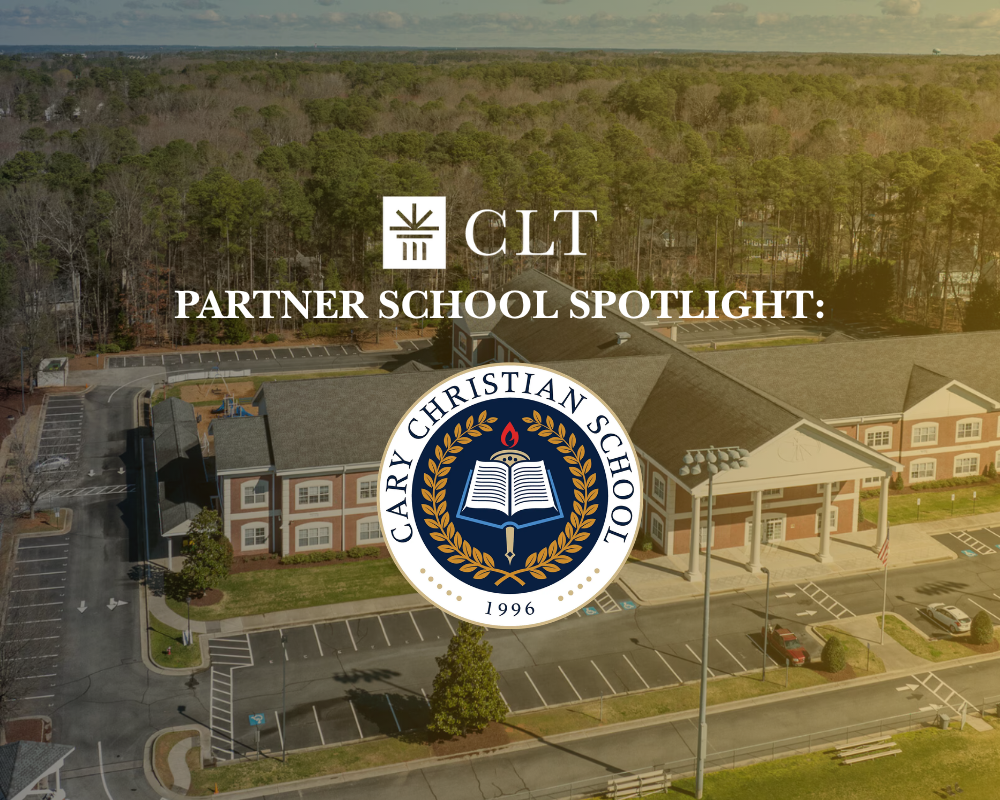
CLT is proud to feature Cary Christian School in Cary, North Carolina as our latest Partner School Spotlight.
Cary Christian School (CCS) is one of the largest and most established classical Christian schools in the nation, serving more than 850 students in grades K–12 and operating continuously since 1996. Accredited by the Association of Classical Christian Schools (ACCS) since 2002, CCS stands among the largest member schools in the association. This scale allows the school to offer exceptional breadth in academics, arts, and athletics while maintaining a unified and faithful commitment to classical Christian education rooted in a biblical worldview.
We asked representatives at Cary Christian School about what makes them unique and how CLT has affected their students and staff. Keep reading to see what they had to say.
What makes Cary Christian School unique?
CCS distinguishes itself through innovative and intentional academic programming. A comprehensive elective program enables students to explore potential college and career pathways, providing meaningful exposure and practical experience prior to graduation. In addition, CCS has established an academic support program designed to ensure that students with learning differences can access the school’s high level of academic rigor. CCS has partnered with a Christian college and certified several distinguished teachers who instruct their classes for Dual Credit opportunities. These programs reflect CCS’s commitment to serving a diverse student body without compromising academic excellence.
CCS also places a strong emphasis on faculty development. The School maintains an intentional teacher training and mentoring program that supports educators who are new to classical Christian education, pairing them with experienced mentors to help them flourish professionally. Through careful attention to academics, culture, and athletics, and a steadfast commitment to meaningful parent-teacher partnership, Cary Christian School has built a thriving community where students and families are equipped to flourish.
How do the arts and athletics fit into your vision of the liberal arts?
We believe the fine arts are a vibrant and rich expression of God’s creation in all its joy, sorrow, tragedy, and comedy. Consequently, CCS students can choose to study music appreciation or participate in one of our band and choral programs. They can study theatre by engaging in every aspect of the production experience through our Main Stage productions or our annual one-act competition. They can also study the visual arts by participating in exhibitions, contests, and portfolio development.
Beyond the classroom, CCS has cultivated a highly competitive athletic program. We have won 19 NCISAA State Championships and produced 148 NCISAA All State Players. Our mission statement is: to provide a competitive athletic program of excellence and sportsmanship modeled after classical education and founded upon a biblical worldview. Athletics introduce standards and assessments to match academics, with the goal of students learning to play a sport in the 4th-5th grades and too compete in a sport in Logic School (6th-8th grades) and Rhetoric School (9th-12th grades).
What traditions does your school incorporate throughout the year to encourage school culture and community?
Community is fostered within the school as a whole through our House System and through our robust selection of student clubs, including Art Club, Chess Club, Literature Club, and the Fellowship of Christian Athletes. CCS upholds the tradition of 8th Grade Tea where students practice elegance and social skills by taking the opportunity to dress up, spend time with classmates and table hosts (parents and Rhetoric School students), and enjoy tea and refreshments together.
Students also have the opportunity to hone their capacity for service and leadership through our structured student leadership roles. In addition, each year senior class executes a Service Practicum. We have developed ministry partners through our annual trip to Newport, Tennessee. Our students use their Spanish skills as they interact with community members in our Coats for the Cold service project. They also engage in meaningful construction projects and spend time as role models with the local Boys and Girls Clubs. In these ways students build relationships with our community and one another in preparation for their entrance into society as adults.
What has your school’s experience been like with CLT? How does CLT fit in with your mission? What effects have you seen on your students and staff?
Prior to adopting CLT, CCS utilized another standardized assessment that consistently produced high marks with little meaningful data, often requiring four to five days of testing and resulting in significant loss of instructional time. Those assessments were closely tied to Common Core or state standards, which did not fully reflect or support the distinct aims of classical Christian education. CLT provided an assessment alternative that better matched CCS’s curricular priorities while allowing for more efficient and purposeful testing. The CLT aligns naturally with CCS’s mission by assessing skills that are central to classical education while drawing on texts commonly encountered in a classical curriculum. Unlike many standardized tests, CLT amplifies the classical movement, allowing CCS to evaluate student performance in a way that is consistent with its educational philosophy. It also enables more meaningful comparison with other classical Christian schools that share similar curricular goals, providing context that is far more relevant to CCS than state‑aligned benchmarks.
We are grateful to partner with Cary Christian School. You can learn more about their mission, campus, and classical model by visiting their website: https://carychristianschool.org/
Also, be sure to check out the recent conversation we had with Kevin Seitz, Dean of Academics at Cary Christian School on The Anchored Podcast, where he shares more about the importance of partnering with parents in education and how teaching through a biblical worldview helps shape students’ sense of purpose and prepares them for life beyond the classroom..