
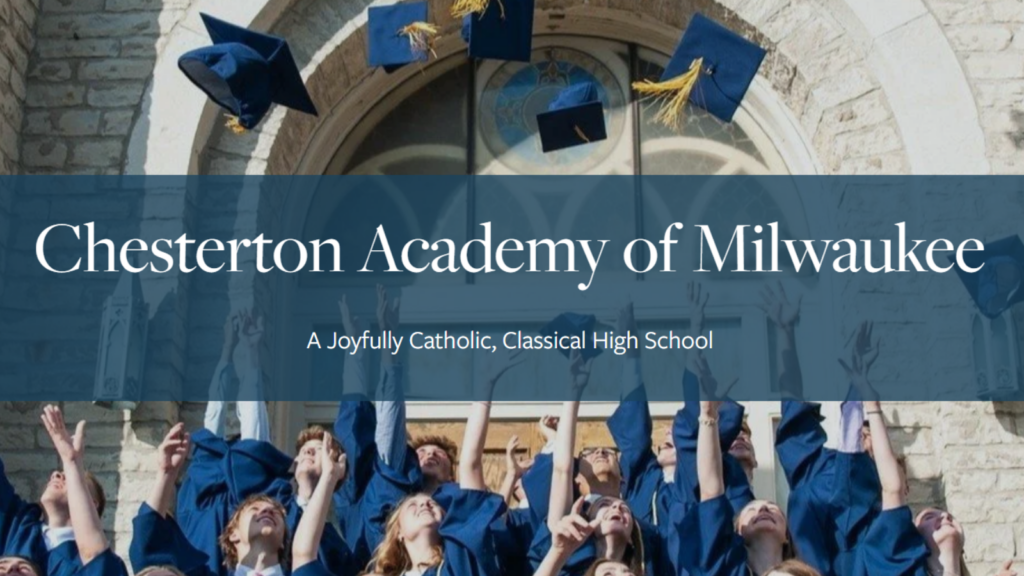
CLT sat down with Dr. Eric DeMeuse, Headmaster of Chesterton Academy of Milwaukee, to discuss the growth of the Chesterton Schools Network, the distinctives of classical Catholic education, and how schools can form students intellectually, morally, and spiritually.
What draws educators and families to classical Catholic education today?
Dr. Eric DeMeuse: My own introduction to classical education didn’t come until college. I had a strong Catholic education growing up, but it wasn’t until I encountered the great texts—Aristotle, the Western tradition more broadly—that something really opened up for me.
I remember reading Aristotle’s Politics as a freshman and being struck by how it challenged my assumptions. It forced me to wrestle with ideas in a deeper way than I ever had before. That experience made me realize that what I had previously understood was only a small part of a much larger conversation—one that stretches across centuries.
That’s what classical education does. It invites students into that broader conversation and forms them through sustained engagement with truth. It’s not just about information; it’s about transformation—learning how to think, how to reason, and how to articulate what is true and good.
How did the Chesterton Schools Network develop, and why is it growing?
Dr. Eric DeMeuse: The first Chesterton Academy opened in 2008 in the Twin Cities. It wasn’t intended to become a network—it was simply founded by parents who wanted a classical Catholic education for their children.
But as that school succeeded, other communities began asking for the curriculum and model. What started as a single school grew organically. When our school in Milwaukee opened in 2016, the network was still small. Today, there are more than 70 Chesterton Academies around the world, with schools across the United States and internationally.
This growth reflects real demand. Families are looking for an education that integrates intellectual formation with moral and spiritual development. The Chesterton model offers that clearly and compellingly.
What makes the Chesterton model distinct?
Dr. Eric DeMeuse: One distinction is that Chesterton Academies are high school–only. Ninth through twelfth grade is a unique stage of development, and it requires a different approach than K–8 education.
We also emphasize a fully integrated curriculum. Students study literature, history, theology, science, and mathematics in a way that shows how these disciplines fit together. As G.K. Chesterton himself said, students should come to see “the whole truth of things.”
In addition, we place a strong emphasis on the fine arts. Students complete four years of art and choir, along with drama and even ballroom dance. The goal is not only to encounter beauty but to participate in it.
At the center of everything is the sacramental life. Students and faculty attend Mass together regularly, and prayer is woven into the rhythm of the school day. We aim to form students who are not only knowledgeable, but also joyful, well-rounded, and ordered toward what is ultimately good.
How do you build a unified culture among students from diverse backgrounds?
Dr. Eric DeMeuse: Our students come from a wide variety of educational backgrounds—classical schools, Catholic schools, homeschool environments, and even public schools. Because of that, we begin with a simple assumption: we presume nothing.
At the start of each year, we hold a two-day retreat. The purpose is to build relationships—between students and teachers, and among the students themselves. We believe that real education begins with trust.
Once that foundation is in place, deeper learning can happen. Students are more willing to engage challenging ideas, ask meaningful questions, and grow both intellectually and personally.
What does transformation look like in practice?
Dr. Eric DeMeuse: Over the years, I’ve seen many students transformed by this environment. One example that stands out is a student who arrived as a freshman, not wanting to be here at all.
Over time, through conversation, mentorship, and the life of the school, he gradually opened up. He built friendships, engaged more deeply, and began to embrace the culture. By the time he graduated, he had become one of our strongest advocates—encouraging others to attend Chesterton Academy.
That kind of transformation happens when students know they are seen, known, and cared for. When that’s in place, they begin to flourish.
How does CLT fit within a classical school model?
Dr. Eric DeMeuse: One of the reasons CLT has been such a good fit for us is that it aligns with our educational philosophy. We don’t spend significant class time preparing students for standardized tests, because our focus is on forming students, not just producing scores.
But what we’ve found is that when you focus on formation—on reading carefully, thinking deeply, and writing clearly—students are actually well prepared for assessments like the CLT.
Good assessments should reinforce learning, not distract from it. CLT reflects that understanding. It serves as a useful benchmark while remaining consistent with the kind of education we’re trying to provide.
What kind of outcomes do you see in your graduates?
Dr. Eric DeMeuse: Our students go on to a wide range of colleges and universities, but what stands out is their intentionality. They ask thoughtful questions about where they want to go and why.
They’re looking for places that will continue to challenge them, help them grow, and align with the formation they’ve received. Colleges are beginning to recognize the value of these students—not just for their academic ability, but for their character, their depth of thought, and their ability to contribute meaningfully to a campus community.
To hear more from Dr. Eric DeMeuse on classical Catholic education and the growth of the Chesterton Schools Network, listen to the full episode of the Anchored Podcast, available on the Classic Learning Test YouTube channel and wherever you get your podcasts.