
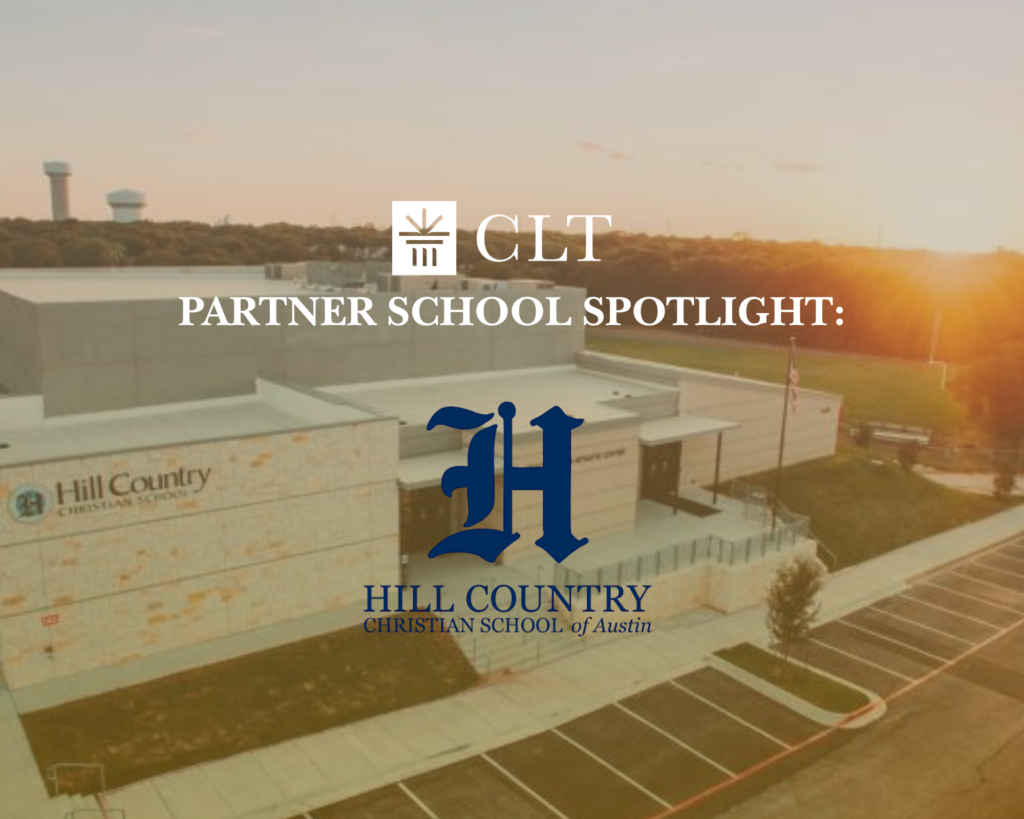
Partner School Spotlight: Hill Country Christian School of Austin

CLT sat down with Eric DeVries, Head of School at Hill Country Christian School of Austin, to discuss his journey into classical education, the growth of his school, and how classical Christian education forms both students and families over time.

What led you into classical education and school leadership?

Dr. Eric DeVries: Like many people in classical education, I had a very traditional public school upbringing. I went on to a private liberal arts university, Whitworth College, where I initially planned to become a music teacher. But after taking my first education class, I thought, “This is a lot of common sense,” and decided to pursue something more intellectually challenging. I ended up earning a theology degree with the intention of becoming a college professor.

That plan changed quickly. I got married during my senior year, and suddenly the reality of providing for my wife set in. Instead of graduate school, I became a youth pastor and served in that role for six years. I loved it, but eventually felt drawn back to academics.

Around that time, a friend introduced me to classical education and encouraged me to attend a conference. My wife and I went, and by the end of it, I knew this was what I wanted to do. I started teaching at a classical school in Washington, and a few years later was asked to step in as interim head of school, which turned into more than a decade of leadership. From there, I served in Alabama before coming to Hill Country Christian School in Austin.

What makes Hill Country Christian School unique?

Dr. Eric DeVries: Hill Country has a few distinctives. First, it’s a ministry of a church, which provides a kind of spiritual guardrail or protection for the school. That comes with challenges—things can move more slowly—but it also helps preserve the school’s mission and culture.

Second, the school has a clear and ambitious vision for growth. We’re currently around 700+ students, with plans to grow closer to 1,000. We also have significant land in North Austin, which allows us to build and expand in a strategic way.

Third, we’re located in a major tech hub. Many of our families work in technology, so we’re intentionally trying to “thread the needle”—remaining fully committed to classical education while also serving families who value strong math and science programs. We’re not trying to choose between the humanities and STEM—we’re trying to do both well.

How do you balance classical education with modern demands like STEM and technology?

Dr. Eric DeVries: It really is a matter of tension—what I call “threading the needle.” There are pitfalls on both sides. If you reject technology entirely, you withhold useful tools from students. But if you overemphasize it, you lose important elements of formation.

You have to acknowledge that tension and consider what different approaches produce in students.

For example, my fifth-grade son is part of an after-school robotics club, and he’s learning to program. That’s not opposed to classical education—that is classical education. Programming requires logic, and logic is a core part of the classical tradition. So it’s not just that it’s robotics—it’s building a tool in students that carries beyond the activity itself.

As your school grows, how do you avoid mission drift?

Dr. Eric DeVries: One of my primary responsibilities as a head of school is to steward the mission—not create a new one. I need to look back and ask what the founders intended and ensure we are still moving in that direction, even as things grow and change.

One of the challenges of growth is that you start adding things—programs, initiatives—often in response to parent demand. Over time, you can end up saying a lot about who you are without revisiting whether all of it is still accurate.

So we’ve been working to clarify and rearticulate our identity—not changing the mission, but making it clearer and more concise. That clarity allows everyone—faculty, parents, and students—to move in the same direction, which is how you protect against mission drift.

What kind of impact does classical Christian education have on students and families?

Dr. Eric DeVries: I’ve seen it impact entire families. You’ll have students learning Scripture and coming home talking about it, and then parents reach out asking for church recommendations. I’ve seen that happen numerous times.

On the student side, what stands out most is long-term formation. I’ve seen hundreds of graduates go into all kinds of fields—military, medicine, law, education—and what they often say is that their education formed in them habits of lifelong learning and a love for Jesus.

The most meaningful moment is when those graduates come back and enroll their own children. That’s when you see generational impact. It’s not just about one student—it’s about families over time.

Why has CLT been a good fit for your schools?

Dr. Eric DeVries: The first thing that sold me on CLT was the simplicity of the data. The previous test we used was so complex that it was difficult to analyze in a meaningful way. With CLT, I could look at class performance or individual student performance without needing specialized expertise.

Over time, I’ve also come to appreciate how well it aligns with what we’re already doing. We don’t want to teach to the test, but it makes sense to use a test that reflects the kind of education we’re providing.

And practically speaking, the time difference matters. Instead of losing multiple days to testing, we can complete CLT in a couple of hours.

How do you think about the role of data in a classical school?

Dr. Eric DeVries: I naturally gravitate toward data, but I also recognize the tension. Classical education can’t be reduced to numbers, but as a school administrator, I want to know if we’re doing a good job.

For example, we identified a grade level where students weren’t making progress over time. That raised questions about whether there might be a curricular issue or something else that needed attention. Without data, we wouldn’t have seen that.

It’s also helpful for identifying patterns in individual students or across subjects. If a large number of students miss the same type of question, that points to something we may need to address.

So while data isn’t the whole picture, it’s an important tool for understanding where we are and how we can improve.

What books have most shaped your thinking?

Dr. Eric DeVries: Plato’s Republic has been one of the most formative books for me in thinking about classical education. It doesn’t necessarily outline how to implement it, but it casts a vision that we’re still trying to work out.

In terms of leadership, Good to Great by Jim Collins and The Advantage by Patrick Lencioni have had a major impact on how I lead and structure an organization.

To hear more from Dr. Eric DeVries on classical education, school leadership, and formation, listen to the full episode of the Anchored Podcast, available on the Classic Learning Test YouTube channel or wherever you listen to podcasts.

Scroll to Top