Period 7: 9th Grade Geometry
It’s the final period of the day with Mr. G. I feel tired, but I’m not exhausted. I’m interested to see what I’ll encounter in this Geometry class – a class that I hated as a 7th grader because I had trouble grasping the concepts.
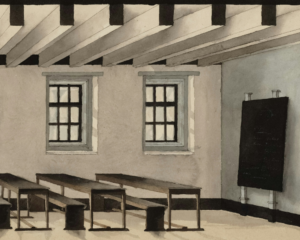
There are paintings, drawings, and the Greek Alphabet on the wall, and there is “stained glass” on the ceilings. Plato is nestled among Euclid on the bookshelf. Class begins.
All of the students stand at the teacher’s invitation and recite 10 statements from Euclid.
“Let it be so,” Mr. G responds.
The students are learning optimization theorems. Mr. G explains that the more orderly a shape is, the better the shape is at doing its job.
A student goes up to the board and presents a theorem, walking the class through each step. The other students clap once the student’s presentation is over.
Another student comes up, struggling more than the other student did.
Mr. G asks, “What would happen to the perimeter of this shape if the area decreases?”
The student squirms a little, visibly unsure, then answers, “Um… it would increase… decrease… increase?”
“Which one?” Mr. G asks, patiently.
Silence.
“Let’s think about it this way. If I walk around the perimeter of this room and I walk around the perimeter of that closet over there, does the perimeter increase or decrease?”
“Decrease.” The student responds, confidently.
“Great, let’s bring it back [to the theorem].”
The student finishes the theorem. Students clap.
Mr. G leads the students in working through Theorem 11. Colored pencils and pens are used to track the different components of the theorem.
Mr. G allows the student to choose their adventure, either starting with part 1 or part 2. I’m sure that this approach adds to how the students are able to eventually grasp the concepts, and it shows Mr. G’s dexterity as a teacher.
He drops gems along the way (“Numbers obscure as much as they illuminate.”…“You can do more with less where the square is concerned. Think of architecture.”…“No, good guess. Try again.”…“For your homework, read this theorem today and tomorrow, and then we’ll discuss it on Friday. You’ll want to encounter this theorem more than once.”).
I followed along with the class, writing notes as furiously as they were. But, I couldn’t let go of the interaction between Mr. G and the second student.
Class ends.
I go up to Mr. G and thank him for allowing me to shadow. He is kind, warm, and thankful for my time. He welcomes any feedback while we have a few minutes together.
I asked him what the class recited in the beginning, to which he responded “Euclid.” They study an abridged version (you thought I recognized those words on my own accord? I’m learning just as you are, remember!)
Another question: “Mr. G, were you classically educated?”
He wasn’t. Public school! He happened across classical education in post-grad and loved what he encountered.
I brought him back to his interaction with the second student – his patience and tenderness with her in not saying, “Thanks for trying, please take your seat,” but, rather, staying with her, saying things in a different way, trying this or that out for size in trying to help her understand. I briefly recount my personal experience with geometry and jokingly lament that I wish he had been my geometry teacher. He smiles, thanks me, and says that when students are struggling, “[he holds] them there because [he doesn’t] want them to let go.”
A future where teachers hold onto their students as the students try to hold on to that which challenges them? Let it be so.
As I leave my last class of the day and begin the journey to my car, I spot a Socrates quote on the wall: “Wonder is the beginning of wisdom.”
As I drive away, I hear echoes of a student from a seminar discussion earlier in the day: “I’m wondering…”
I hope that these posts invite you into wonder and spur you on to enter (or re-enter) the Great Conversation, which is so much of classical education.
Didn’t receive a classical education? Great, start receiving one today, right where you are.
Want to know where to start? Choose an author from our Author Bank, Google their best works, and choose a book. I started with The Great Gatsby by F. Scott Fitzgerald last year. It’s easy to read and glitters with imagery and descriptions that few books today do.
Thanks for reading and happy adventuring!