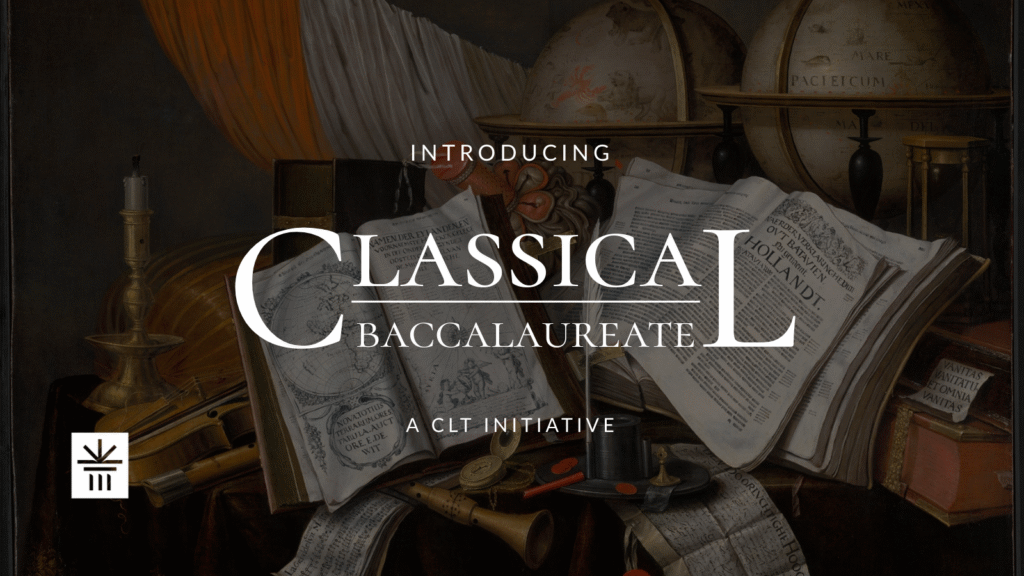
CLT sat down with Alex Julian, Director of Classical Baccalaureate (CB), to unpack what CB is and what it means for students, parents and educators.
What is Classical Baccalaureate, and why should students, parents, and educators be excited about it?
Alex Julian: If you’re a student or parent in a classical school, there’s a real challenge today: colleges often don’t give classical students the recognition they deserve for what they’re accomplishing.
These students are reading great texts from cover to cover. They’re doing demanding mathematics—many reading Euclid’s Elements. They’re studying conceptual science. They’re constantly being asked to think, reason, and carry a heavy cognitive load throughout high school in a way that most other students, even those in rigorous programs, are not.
I would argue that classically educated students are among the most prepared to succeed in college.
Yet there’s no clear metric to communicate that. Other than GPA—which is vague and increasingly unreliable—there’s no way for colleges to see just how impressive a classical education really is.
Classical Baccalaureate exists to solve that problem. It gives colleges a clear signal that a classically educated student belongs at the top of the admissions pile and deserves the scholarships that reflect their preparation.
CB will include a diploma program and a diploma score. It will also communicate that students have completed college-level coursework and should be eligible for college credit at institutions that grant it, similar to Advanced Placement (AP) or International Baccalaureate (IB). That can significantly reduce the cost of college for families.
It also benefits students who still want the full four-year college experience—which we strongly recommend. With credit in hand, they can pursue opportunities like double majors, pairing the humanities with a highly targeted or technical field. That combination is extremely attractive to employers.
For schools already offering classical education, CB validates the work teachers and students are doing. For schools that aren’t classical, CB opens the door to more options. A public school might offer it as a track. A new school might launch with a classical model and succeed from day one.
In that sense, CB meets unmet demand—bringing high-quality classical education to families who want it but don’t currently have access.
Why should legislators and college admissions offices be excited about this?
Alex Julian: With AI now involved, colleges don’t know who’s writing essays or recommendation letters. GPA data also shows years of grade inflation—we have more 4.0 GPAs than ever before but alongside have the highest historical high college dropout rates.
Those are not good trends. Colleges that care about more than just enrollment numbers want students who will stay, graduate, pursue advanced study, and represent their institution well as alumni. That’s why AP and IB already tend to rise to the top of the admissions pile—they’re imperfect, but they’re external signals of rigor and thinking ability.
Classical Baccalaureate offers something deeper. These students have been formed by sustained engagement with questions like: What do I owe society? What does it mean to be a citizen? How do I understand the last 2,000 years of civilization, and how do I contribute to it in my own time and place? It reflects the spirit of JFK’s maxim:
“Ask not what your country can do for you, but what you can do for your country.”
CB students are prepared to contribute—to their colleges, their communities, and society—rather than simply criticize or tear institutions down. That is a central part of what a Classical Baccalaureate credential will signal to colleges.
For legislators, the question is similar. Do you want citizens who leave their communities for a handful of major cities, or citizens who return, invest, and give back to the places that formed them? Do you want citizens who love their country and state, contribute meaningfully, raise families, and pursue happiness in the way the founders intended?
What is the current status of Classical Baccalaureate, and when will it be fully running?
Alex Julian: There are two timelines: one based on our current resources, and another that becomes possible with additional support. Our realistic goal is to launch a selective pilot by fall 2027, with schools implementing CB beginning in sophomore year, allowing students to graduate with a CB diploma by 2030.
A subsequent goal is to build out full support systems so CB can be implemented in schools that aren’t yet ready to pilot it independently. With additional funding, we can expand training, curriculum, and infrastructure to support faithful implementation at scale.
In either case, our long-term goal is a full K–12 CB model with comprehensive wraparound support—one that public districts or private startup schools can adopt from kindergarten through graduation.
Would CB function like AP classes within a school?
Alex Julian: Yes. Schools could replace AP courses or exams on a one-off basis if they choose. We will offer CB exams and CB courses that can be implemented independently of the full diploma program. Even schools that don’t pursue the full CB diploma may choose CB courses because they better align with their mission. We’ll begin releasing courses à la carte, starting with CB U.S. Government and Politics and CB English Language, with additional courses added each year.
What challenges does CB face, and what do you hope its long-term legacy will be?
Alex Julian: This is a bold vision, and it can’t be built all at once. It requires time, talent, and significant resources. We can move as fast as demand allows, provided there’s sufficient support from legislators, donors, and partners.
As for legacy, the vision is simple but ambitious: every student should have access to a high-quality classical education—public or private, in the U.S. or abroad. As Mortimer Adler said,
“The best education for the best should be the best education for all.”
Classical education was once reserved for the ruling class. In a democracy, that education should be available to everyone—because we are all responsible for self-government. Classical Baccalaureate exists to make that vision real.
To hear more from Alex Julian and the new Classical Baccalaureate program, check out the latest episode of the Anchored Podcast, where he sits down with Classic Learning Test founder Jeremy Tate to discuss the genesis of CB, the ideas behind the program, and more.
Available on the official Classic Learning Test YouTube channel, or wherever you listen to podcasts.