Classical Education Through a Novice’s Eyes
By Taylore Hopkins
Estimated Reading Time: 8 minutes
As support for CLT spreads nationwide, our core audience remains homeschooled and classically educated students. I was familiar with homeschooling as a model of education prior to my time at CLT, but I’ve only encountered classical education in the past few years through my work with our college partners.
During my time at CLT, I found myself desiring to go deeper into the tradition to learn more about classical education, both for myself and to be able to share it with others.
Introducing My "Day in the Life" Series
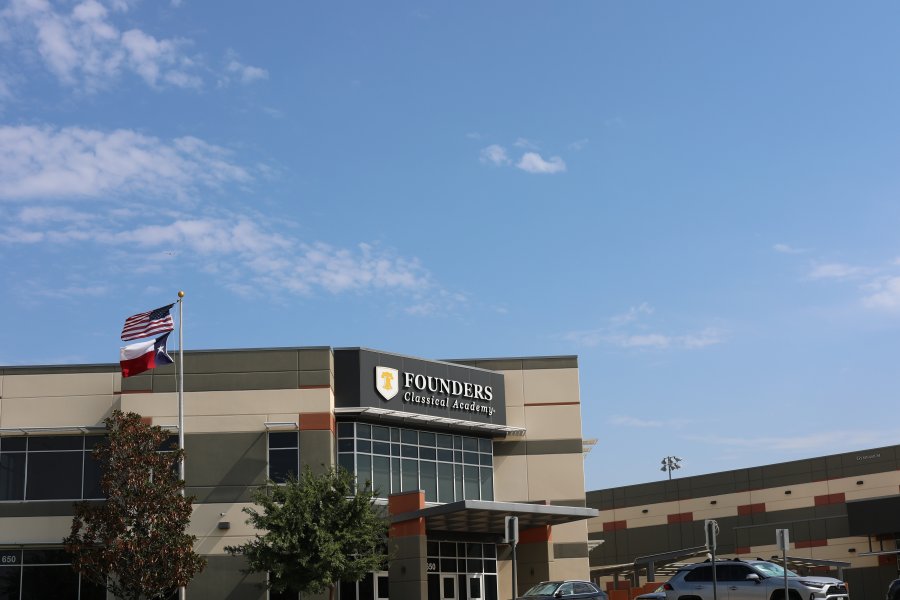
Throughout this series of posts, I will first tell you more about classical education, providing you with basic definitions and discoveries from my preliminary research. Then, I will take you along with me for a “day in the life” I experienced going to school at Founders Classical Academy in Lewisville this February. (If you’re like me, this sounds like fun; if you’re not, this probably sounds like your worst nightmare – but I wonder what you’ll think after reading about this school day.)
Founders Classical Academy is “…a public, tuition-free, independent charter school accredited by the Texas Education Agency. [They] serve students in grades K–12 with a classical liberal arts and sciences curriculum. FCA is part of the Responsive Education Solutions (ResponsiveEd) network of charter schools.” Founders is a network of schools, and I visited the Lewisville campus – its original location.
Before we dive in, I want to note a few things as we get acquainted with each other:
In no way is this research in the truest sense. I didn’t visit for multiple days or ask an Institutional Review Board for their approval. I didn’t interview students and teachers outside of casual conversations that happened organically. I truly wanted this day-in-the-life to be a fly-on-the-wall experience.
There are other organizations and people who are the true experts on classical education, and I will direct you to some of them. These blog posts just scratch the surface.
I want to respect the names and identities of students and teachers at this school. Therefore, teachers will be named very creatively – “Mr. A,” “Mr. B,” “the student,” etc.
My goal is not to explicitly describe how Founders differs from other schools, but, rather, I’d like to invite you to consider for yourself how Founders is different from other schools and how classical education as a whole is different from the education that you may have received.
I’m a public school graduate and feel thankful that the concepts I heard discussed in class felt distant but not new to me. I attribute this experience mainly to English teachers who made sure that my peers and I interacted with the likes of Shakespeare, Morrison, and Orwell. I also have a mom that taught me to love learning and reading. One of my favorite weekend activities as a kid was going to our local bookstore or library with her.
A public school education is different today than it was ten, twenty, or thirty years ago – that fact is undeniable. A classical education is a rich, full method of educating and it is the fastest growing model of education in the United States today. That fact is also undeniable.
I write these posts not as a public school graduate spurning the public school system forever, but as a hopeful young professional, proud to work at an organization that contributes to a future where classical education is just education in America.
Defining Classical Education
Classical education is a model of education which seeks to form wise, virtuous human beings by inviting them to feast on truth, goodness, and beauty.
What are core beliefs of classical education?
First, humans are intrinsically valuable. Second, truth is objective and knowable. And third, western tradition matters and should be preserved. Classical education is the mode of education through which truth, goodness, and beauty can be transmitted.
In practice, the liberal arts are foundational to classical education, meaning that grammar, logic, rhetoric, arithmetic, geometry, music, and astronomy are disciplines that matter to the classical educator.
Are the teachers in these schools different from those in other schools?
We all have teachers who have impacted us, whether private, public, or at home. I’m sure that you’re thinking of at least one right now. In the teachers at Founders, I observed a particular level of respect for their craft (and I do mean craft). Jason Caros, the Executive Director of the Founders Classical Academies, teaches that the classical educator is both “a sage on stage and a guide on the side.” Teachers lead from the front of the room, but there is an emphasis on discussion amongst students.
How does Founders Academy live out their commitment to classical education?
You can find Founders’ commitments on their website: https://foundersclassical.com/academics/commitments. While reading this blog series, I invite you to keep a few of their commitments at the top of your mind: teaching virtue and self-government, promoting dialogue, and offering a rich curriculum that includes language, math, science, the Great Books, and the performing arts.
Below you can find some links to sources that I used as a jumping off point for this research, including a few newsletters written by Jason Caros, the Executive Director of Classical Academies:
- The Four Elements of Classical Education (CiRCE Institute)
- The Elements of Classical Education (Society for Classical Learning)
- Classical Education: The Oldest Ideas for the Youngest Minds (Jason Caros)
- 21st Century Education: Classical and Progressive Education (Jason Caros)
- Touching the Hem of Christ’s Garment (Jason Caros)
- What is the Heart of Classical Education? (Jason Caros)
A Day at Founders Classical Academy
Period 1: 9th Grade Latin
Students stand up and say the Pledge of Allegiance, the Texas Pledge (I saw that eye roll of yours!), and the Student Motto (Honor, Respect, Service, Excellence, and Perseverance).
Mr. A begins class by passing out graded assignments and letting the students know their quiz will begin in 4 minutes. Students sleepily talk amongst themselves, glance at their notes one final time, or simply sit and wait for the quiz to begin.
The quiz starts. I look around the room. The school motto (“Scientia, Virtus, Libertus”) is one of the wall decorations. Wheelock’s Latin, a book described on the cover as “the classic introductory Latin course, based on the writings of Cicero, Vergil, and other major Roman authors,” is on every desk. The intellectual virtues (knowledge, understanding, wisdom) and cardinal virtues (courage, moderation, justice, and prudence) are listed on the wall. The etymology of the week is written on the board (admiration: ad + miror or “to marvel” + -tion or “the action or condition of marveling at something”).
Quizzes are done. Students learn there will be a grammar quiz on Friday and receive a review of datives and a translation of a reading passage to practice as a class before Friday’s quiz. Class ends with a culture lesson about Tiberias, an administratively gifted ruler whose son’s death devastated him to his core, affecting his leadership thereafter.
Period 2: 10th Grade English
I’m plunged right into the familiar rush of people shuffling in the halls, trying to make it to their next class before the bell rings. I arrive a little early to 10th grade English. I find a seat and start talking to two students. One attended a public school until the 7th grade before coming to Founders. She likes things about both schools, but the culture here is healthier, in her words. I thank them for their kindness to me and look around before class begins.
The American and Texas Flags are hanging in the corner. There is a beautiful tapestry hanging near the teacher’s desk. The intellectual and cardinal virtues as well as the school and student mottos are on the wall. I discover that you’ll find some combination of all of these things in every room as I go throughout my day. A big, plush couch is also in this room – a thing that is not in every room, but it is certainly in more than one! (Spoiler alert: I will admittedly opt for the couch instead of a desk in one of the classes I observe later that day).
“To be or not to be… is that the question?” Mr. B poses the problem for the class before handing out their next assignment.The students are reading Shakespeare’s Hamlet. Tonight’s homework is to consider what questions Hamlet should be asking as a man, a lover, a prince, and a son. To earn credit for tomorrow’s seminar, students must come prepared, participate, and back up their arguments with evidence.
“Without evidence,” Mr. B asks, “how do you even know that what you are arguing is what Shakespeare meant?”
Mr. B claps his hands. “Alright, can someone pull down the projector screen for me?”
Two boys race to the front, jostling each other to make it there first. Mr. B scolds them and asks one of them to return to their seat. I smile. These students are receiving a rich education, but, at the end of the day, they are still students, growing and learning as they journey towards adulthood.
The students watch a 1996 movie re-enactment of Hamlet’s “To be or not to be” monologue. They’ve watched Mel Gibson’s and Ethan Hawke’s performances before this one. Mr. B asks them to tell him about this certain portrayal and compare it to the others they’ve watched, inviting them to consider what they can learn about the nature of theatrical interpretation.
Students answer and respect one another in the process (“Did you finish your point?”). Mr. B challenges them in various ways as they answer: “How?,” “Use different words,” “What does that convey?,” “Do you think…,” “I can’t hear you, speak up.”
Class ends with certain students sitting at the front of the room to read and act out Act 3, Scene 2. And… scene.
Join me next week as I continue describing my day in the life of a student at Founders Classical Academy! Be sure you subscribe to our email newsletter so that you never miss an update.
Taylore Hopkins is the Director of College Partnerships at CLT.
If you enjoyed this piece, be sure to check out The Anchored Podcast. For more Journal content, check out this post on whether or not tests are classical. From all of us at the Journal, thanks for reading and have a great rest of your week.
Published on 4th August, 2026.