
What is a Good Score on the CLT?

By Emily Andrews
Estimated Reading Time: 8 minutes
You worked hard and did your very best to represent your true potential on the CLT. Now that test day is over and you have your score in hand, perhaps you’re unsure how to feel about your performance. Maybe you’re asking yourself: “Is my CLT score good?”
Below we’ll go over some tools that will equip you to think hard about your score and what you can achieve with it. Before we do, however, you should know that just taking the CLT helps you stand out from the crowd! Many of the prestigious institutions that have partnered with CLT tell us that a student’s mere interest in the CLT tells them a great deal about the character and ability of that student.
Congratulations! You’ve taken an important step toward a successful and fulfilling future. Now let’s dive into the details so that you can make informed decisions about where to go from here.
Understanding Your CLT Score
The CLT is scored out of 120 and there are 120 questions on the test. That does not mean, however, that your score represents the number of questions you got correct. We call the number of questions you got right out of 120 your raw score, but it is important to recognize that your raw score is not your final score.
Adjustments are made to your raw score to account for slight differences in the difficulty of individual test forms and/or test administrations. For example, a raw score of 90 on a more difficult test indicates a higher level of achievement than a score of 90 on a slightly easier test. Your scaled or final score reflects such differences.
Therefore, dividing your score by 120 to find a percentage will not give you a reliable indicator of the quality of your performance.
Compare Your CLT Score
A better way to understand your score is to look at your CLT Percentile. This number, included as a part of your score report, tells you the percentage of CLT test takers who earned the same score as you or lower. For example, a CLT score of 79 is at the 57th percentile, meaning a student who scored a 79 has a score equal to or better than 57% of all testers, and is therefore in the top 43% of all CLT test takers.
You can quickly get an idea of your performance in context by looking at the visual representation of your score in the bell-shaped chart included with your score report:
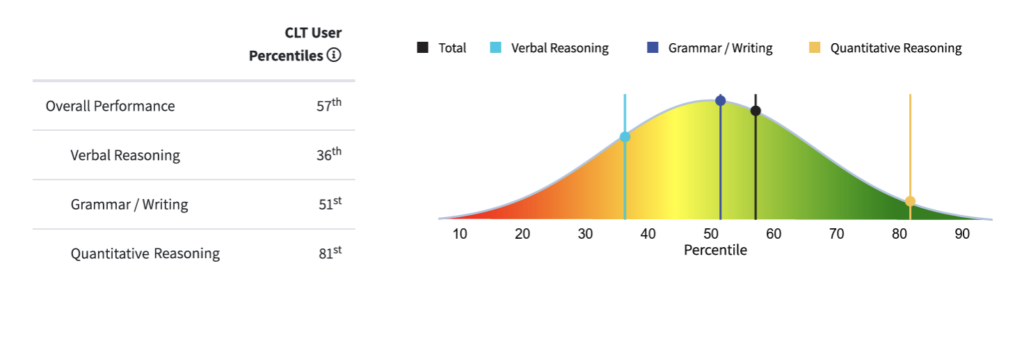
As demonstrated in the sample chart above, the black vertical line indicates where your total CLT score falls in the distribution of all scores earned by CLT test takers. The highest point of the curve represents the national average score – the score achieved by the greatest number of test takers. In the example above, the black line falls to the right of the curve, meaning the score sits above the average. Any scores that fall to the left of the curve indicate a score lower than average. The farther your line rests to the left or right of the chart, the further below or above average your score.
The chart also represents your performance on each section of the test in comparison to other test takers. In the given example, the test taker performed exceptionally well in the Quantitative Reasoning section, but achieved a below average score in Verbal Reasoning.
To read more about how to interpret your CLT analytics, read our official Score Interpretation guide.
Know What Your CLT Score Can Do For You
While it can be useful to know how your score compares to other test takers, its true value will ultimately be measured by its ability to help you achieve your college goals. Each one of the 400 colleges and universities that accepts the CLT has their own measure of a “good” score. The best way to see what your score can achieve is to visit the individual websites of these institutions and learn about their requirements for admission.
You can also visit our website to learn about different scholarships available to CLT test takers and the various scoring requirements they demand.
Here is a brief sampling of the standards set by some of CLT’s Private Partner Colleges:
- Benedictine College automatically admits students who earn a score of 72 or higher on the CLT and invites students who earn a score of at least 84 to enter their Presidential Scholars Competition which awards 15 scholarships up to full tuition.
- Grove City College has reported a 94 CLT score average for admitted students. A score of 100 or higher is required to be considered for the President’s Scholarship Program.
- For Hillsdale College, it is recommended to achieve a score of at least 100 for admission consideration according to the current score concordance table. A score of 110 or higher is considered competitive.
- Liberty University awards $1000 annually to admitted students who earned a score of 81 or higher on the CLT. Students who achieve a 112 or higher earn full tuition.
- New College Franklin awards merit-based scholarships covering up to 50% of tuition for applicants who submit a CLT score of 90 or higher.
- The University of Dallas has announced an auto-admit program for students who score 88 or higher on the CLT.
Here is a sampling of the standards set by public universities that accept CLT scores:
- The requirements for Florida’s Bright Futures Scholarship state that students who earn a score of 83 or above are eligible for the Florida Medallion Scholars award and may receive up to 75% of tuition and applicable fees covered for up to five years. Those who score a 96 or above are eligible for the Florida Academic Scholars award and may receive an award amount equal to 100% of tuition and applicable fees for a maximum of 120 semester hours toward the completion of a first baccalaureate degree.
- Students who score in the range of 79-88 and have a cumulative GPA between 3.70–3.79 are eligible for the first tier of the University of West Florida’s Academic Merit Scholarship.
- The state of Texas has announced that students who earn a cut score of at least 40 on the Verbal Reasoning and Grammar sections and 20 on the Quantitative Reasoning section, and who meet the other requirements enumerated by the program, are eligible for auto-admission to Texas public universities and colleges.
- Iowa’s Board of Regents provides a conversion table that allows students to calculate their CLT scores as a part of the formula for automatic admission.
What To Do Next With Your CLT Score
If you are pleased with the results of your score, you can share it for free with as many colleges as you like through your CLT student dashboard. However, if you would like to improve your score, use the domain and subdomain scores in your analytics report to target the skills you need to practice and then sign up for the next CLT test date. Because CLT allows you to view your scores before sending them to your preferred colleges, you are empowered to select which scores you share.
Do You Have a “Good” CLT Score?
At CLT, we believe students are so much more than a number. No matter the official score attached to your report, taking the CLT means you have invested time and energy into engaging with rich texts and practising complex skills. That investment will serve you well beyond your college years.
While test scores certainly have an impact on your immediate options for higher education and career opportunities, the capacity for reasoning and analysis that the CLT requires is a quality that (if given proper attention) will continue to deepen over your lifetime. No matter where you begin, simply beginning to develop these skills is an achievement worth celebrating. Doors will open to you throughout your life if you continue to practice them!
We wish you the very best as you pursue your goals. No matter what, if you applied yourself sincerely to the demands of the CLT exam, your score is good enough in our books!
Emily Andrews is the Marketing Content Manager for CLT. She lives with her husband and daughter in Spokane, WA and enjoys hoarding books, eating good meals, and failing to complete crossword puzzles.
If you enjoyed this piece, be sure to check out The Anchored Podcast. For more Journal content, check out this post on how to share your test score with colleges. From all of us at the Journal, thanks for reading and have a great rest of your week.
Published on 20th October 2026.